
The Propositions Method: Enhancing Information Retrieval for AI Systems

In the world of AI and information retrieval, we’re always looking for ways to improve how systems find and use relevant information. One method that’s gaining attention is the use of propositions. Let’s explore what this method is, why it’s useful, and how it can be implemented.
What are Propositions?
Propositions are small, self-contained units of information. Think of them as individual facts or claims that can stand on their own. Here are the key characteristics of propositions:
1. They contain a single piece of information.
2. They can be understood without additional context.
3. They state a clear fact or claim.
4. They are concise and to the point.
5. They include any necessary context within themselves.
For example, instead of a paragraph about World War I, you might have propositions like:
- “World War I began in 1914.”
- “The assassination of Archduke Franz Ferdinand was a catalyst for World War I.”
- “World War I involved many European nations.”
Why Use Propositions?
Traditional methods of splitting text into chunks (like paragraphs or sentences) can have some drawbacks:
- Important information might be split across multiple chunks.
- Chunks might contain irrelevant information along with the relevant bits.
- It can be harder to pinpoint exactly the information needed to answer a specific question.
Propositions aim to address these issues by breaking information down into its smallest meaningful parts.
How to Implement the Propositions Method
Here’s a basic guide to implementing the propositions method:
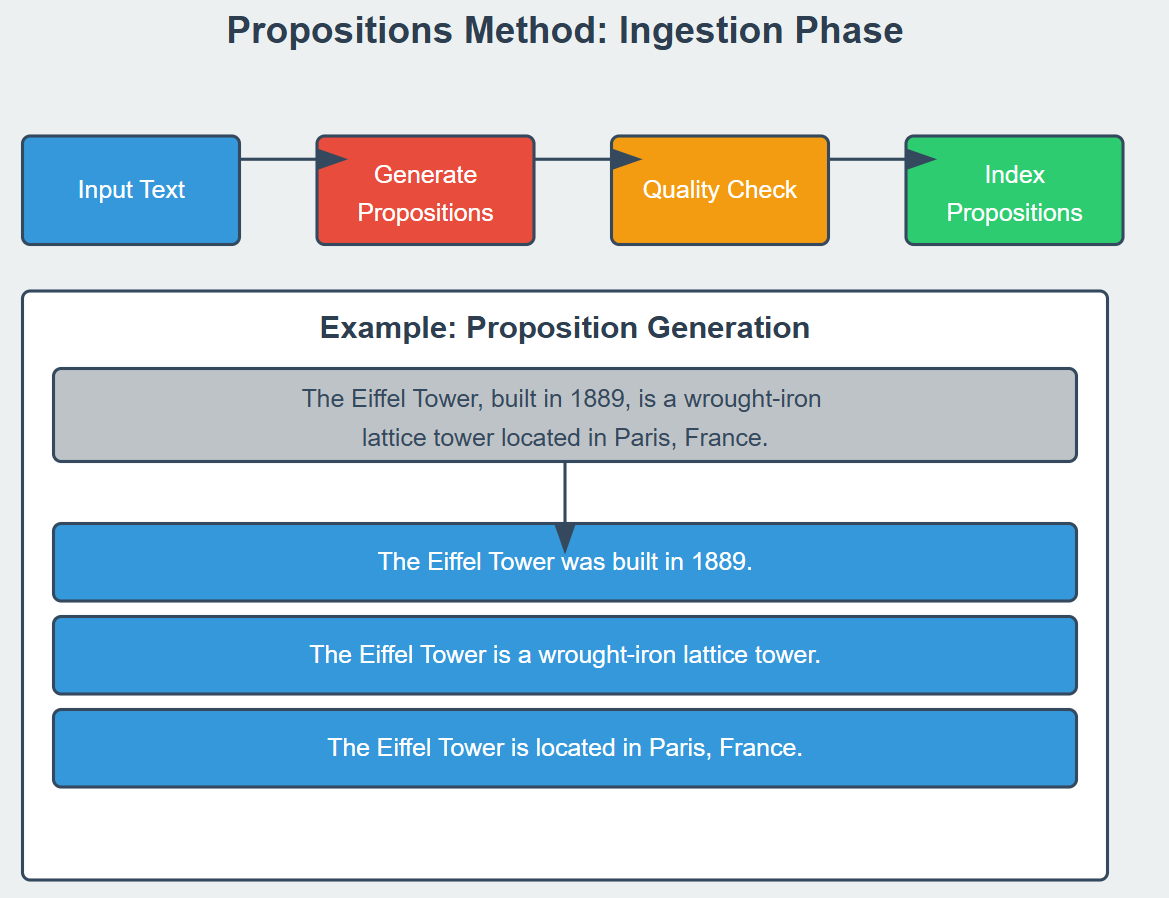
1. Prepare Your Data: Start with your text documents and clean them up.
2. Generate Propositions: This is the key step. You can:
— Use a large language model with careful prompting to break text into propositions.
— Train a smaller model specifically for this task.
— Use rule-based systems for more structured data.
3. Check Quality: Review a sample of the generated propositions to ensure they meet the criteria of being self-contained, factual, and concise.
4. Index the Propositions: Use a method like dense retrieval to create searchable representations of your propositions.
5. Retrieval: When a query comes in, use your indexing method to find the most relevant propositions.
6. Use in Your System: Feed the retrieved propositions into your AI system to generate responses or perform other tasks.
Potential Benefits
Using propositions in your information retrieval system could lead to:
1. More precise retrieval of relevant information.
2. Better handling of complex queries that require multiple pieces of information.
3. Improved ability to scale to larger amounts of information.
4. More accurate AI responses due to more precise input information.
Challenges to Consider
While the propositions method has potential benefits, it’s important to be aware of some challenges:
- Generating high-quality propositions can be computationally intensive.
- The approach may need to be adapted for different types of information or different fields.
- Finding the right level of detail for propositions can be tricky.
Looking Forward
As AI and information retrieval continue to evolve, we might see developments like:
- Systems that can adjust the level of detail in propositions based on the query.
- Expansion of the propositions approach to include non-text information.
- Ways for propositions to link together dynamically to form more complex knowledge structures.
The propositions method offers a new way to think about how we represent and retrieve information for AI systems. While it’s not a magic solution, it has the potential to improve the precision and effectiveness of information retrieval in many applications.
If you’re working on AI systems that involve retrieving and using information, the propositions method might be worth exploring as part of your toolkit.
If you’re interested in implementing these techniques, check out my RAG techniques repository at https://github.com/NirDiamant/RAG_Techniques for practical examples and advanced approaches.
— -
If you found this article informative and valuable, and you want more:
Join our Community Discord
Connect with me on LinkedIn
Follow on X (Twitter)
🤗 And of course:
#Propositions #RAG #AI #MachineLearning #InformationRetrieval